The Intersection of Technology and Brain Health
The relationship between cutting-edge technology and modern medicine has never been more consequential than it is today. Across the globe, healthcare systems are undergoing a quiet but profound revolution — one driven not only by pharmaceutical breakthroughs but by the integration of robotics, artificial intelligence, and precision diagnostics into everyday clinical practice. Nowhere is this transformation more visible than in the field of neurology, where the complexity of the human brain demands the most sophisticated tools available. For patients in the UAE and the broader Middle East, this shift is not a distant promise — it is already happening in specialized centers that have committed to bringing world-class neurological expertise to the region.
Why Neurological Disorders Demand Specialized Attention
Neurological conditions — ranging from epilepsy and Parkinson’s disease to stroke, multiple sclerosis, and rare movement disorders — affect hundreds of millions of people worldwide. Unlike many other medical conditions, disorders of the brain and nervous system often resist simple solutions. They require multidisciplinary teams, long-term management strategies, and access to diagnostic technologies that can detect subtle changes in brain structure and function before symptoms become debilitating.
The stakes are extraordinarily high. A delayed diagnosis of a brain tumor, a missed early sign of Alzheimer’s disease, or an improperly managed stroke can have life-altering consequences. This is why the quality of neurological care — and the expertise of the specialists delivering it — matters so deeply to patients and their families.


See also: SS-31: What the Trial Data Actually Show, and Why the Approval Doesn’t Mean What Sellers Imply
The Growing Burden of Neurological Disease in the UAE
The UAE, like many rapidly urbanizing nations, is experiencing a rising prevalence of neurological conditions linked to lifestyle factors, aging populations, and increased diagnostic awareness. Conditions such as migraine, diabetic neuropathy, and cerebrovascular disease are becoming more common, placing greater demand on specialized neurological services. At the same time, the country’s diverse expatriate population brings a wide range of genetic predispositions and health histories, making comprehensive neurological evaluation all the more essential.
Robotics as a Game-Changer in Neurological Surgery and Rehabilitation
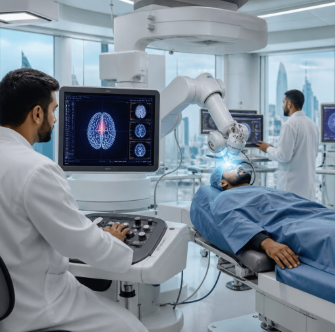
One of the most exciting developments in modern neurology is the integration of robotic systems into both surgical procedures and patient rehabilitation. Robotic-assisted neurosurgery allows surgeons to operate with a level of precision that was previously unimaginable, minimizing damage to surrounding brain tissue and reducing recovery times significantly. Stereotactic robotic platforms can now guide electrodes to exact coordinates within the brain for procedures such as deep brain stimulation — a treatment that has transformed outcomes for patients with Parkinson’s disease and essential tremor.
Beyond the operating room, robotics is playing an increasingly important role in neurological rehabilitation. Exoskeleton devices and robotic therapy systems help patients recovering from stroke or spinal cord injury to relearn movement patterns through repetitive, precisely controlled exercises. These technologies accelerate neuroplasticity — the brain’s remarkable ability to rewire itself — and are helping patients achieve functional recoveries that would have seemed impossible a decade ago. As explored in depth by industry analysts, robotics is fundamentally changing the landscape of multiple industries, and healthcare is among the most profoundly affected.
Artificial Intelligence in Neurological Diagnostics
Alongside robotics, artificial intelligence is reshaping how neurological conditions are detected and monitored. Machine learning algorithms trained on thousands of MRI scans can now identify early markers of neurodegenerative disease with accuracy that rivals — and in some cases surpasses — that of experienced radiologists. AI-powered electroencephalogram (EEG) analysis is improving epilepsy diagnosis, while natural language processing tools are being used to detect subtle cognitive changes in patients at risk for dementia. These innovations are not replacing neurologists; they are equipping them with sharper tools to make faster, more accurate clinical decisions.
Cleveland Clinic Abu Dhabi: A Center of Neurological Excellence
For patients in the UAE seeking access to this new era of neurological care, Cleveland Clinic Abu Dhabi represents a landmark resource. The institution has built a reputation for combining internationally trained specialists with state-of-the-art diagnostic and treatment infrastructure. Consulting a neurologist abu dhabi at Cleveland Clinic Abu Dhabi means accessing a team that approaches each patient’s condition with the same rigor and individualized attention that defines the Cleveland Clinic model globally. From complex epilepsy management to neuromuscular disease, the Neurological Institute offers a comprehensive range of subspecialty services under one roof.
What distinguishes this center is not only the breadth of its clinical offerings but its commitment to evidence-based medicine and continuous innovation. The institute’s neurologists work alongside neurosurgeons, neuroradiologists, neuropsychologists, and rehabilitation specialists to ensure that every patient receives a coordinated, holistic plan of care. This team-based model is particularly valuable for patients with complex or rare neurological conditions who require input from multiple disciplines to achieve the best possible outcomes.
Training the Next Generation of Neurological Specialists
The future of neurological care depends not only on today’s technology but on the quality of tomorrow’s physicians. Medical education programs that emphasize clinical exposure, research, and the integration of emerging technologies are essential to building a workforce capable of meeting the growing demand for neurological expertise. Institutions that invest in training environments where students and residents encounter real-world complexity — and are challenged to think critically about diagnosis and treatment — produce physicians who are better prepared for the realities of modern practice. Those interested in understanding what drives excellence in medical training can explore how leading medical schools are addressing critical gaps in healthcare through innovative educational approaches.
What Patients Should Know When Seeking Neurological Care
Navigating a neurological diagnosis can be overwhelming. Patients and families are often confronted with unfamiliar terminology, uncertain prognoses, and a bewildering array of treatment options. The most important step any patient can take is to seek evaluation from a qualified neurologist as early as possible. Early diagnosis consistently improves outcomes across virtually every category of neurological disease, from stroke and brain tumors to autoimmune encephalitis and movement disorders.
When choosing a neurological care provider, patients should consider the depth of subspecialty expertise available, the diagnostic technologies in use, and the degree to which the care team collaborates across disciplines. Access to clinical trials and emerging therapies is another important consideration, particularly for patients with conditions that have limited standard treatment options.
Conclusion: A New Standard for Brain and Nervous System Care
The convergence of robotics, artificial intelligence, and specialized medical expertise is setting a new standard for what neurological care can achieve. Patients no longer need to travel abroad to access world-class diagnosis and treatment for conditions affecting the brain and nervous system. In Abu Dhabi, institutions with deep clinical expertise and a commitment to innovation are making it possible for patients across the region to receive care that is both globally competitive and locally accessible. As technology continues to evolve and our understanding of the nervous system deepens, the outlook for patients living with neurological conditions grows steadily more hopeful.